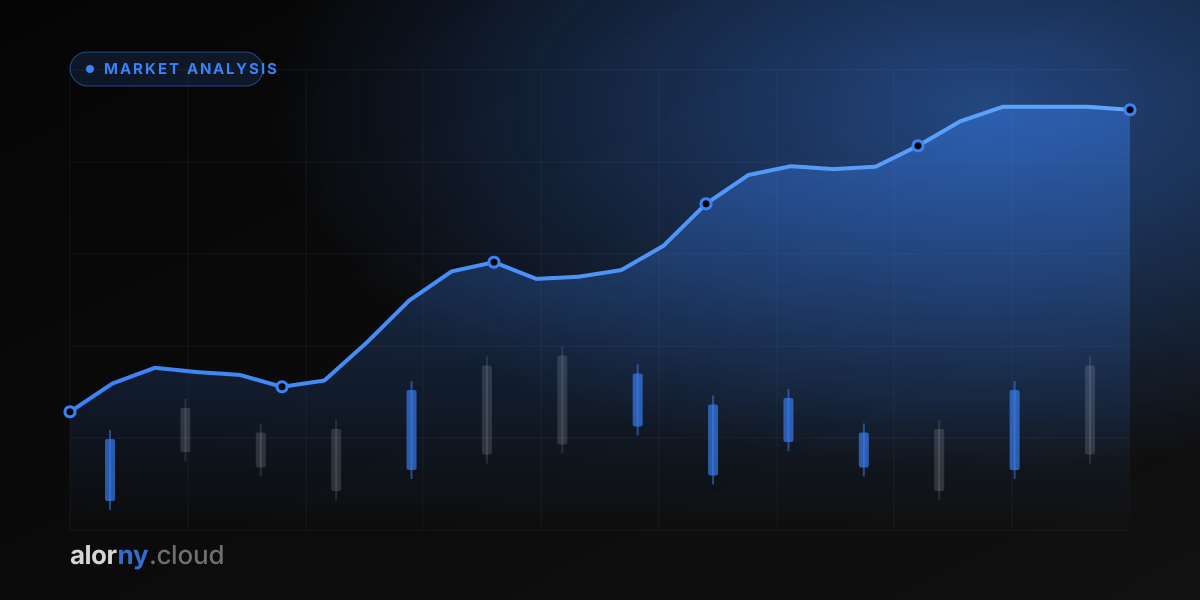
The Equity Cliff: Why Winning Bots Blow Up
A $10K account runs your AI forex trading bot for 3 months. It hits a 15% return. So you double the lot size. Two weeks later, a drawdown wipes out 22% of equity and your bot is dead. You're not alone—most DIY traders follow the same path: make money, panic-scale, lose money, quit.
The problem isn't the bot. It's that you never defined how much capital each trade should risk. Most traders build an AI forex trading bot then run it like a slot machine, hoping the next trade is the one that compounds their millions. Professionals do the opposite—they build the equity management system first, then attach the bot to it.
What Professionals Know About Equity Curves
An equity curve is a graph of your account balance over time. It's the most important metric you'll ever track. When your AI forex trading bot is making trades, your equity curve tells you one thing: is this sustainable?
Most retail traders check their bot once a day and see the balance. Professionals draw equity curves and ask three questions:
- Is the drawdown staying within acceptable limits?
- Is the win rate holding above the minimum threshold?
- Is capital growing fast enough to justify the risk?
If any answer is no, they stop scaling. If all three are yes, they add capital in phases, never all at once.
The Position Sizing Framework That Stops Blow-Ups
Here's the thing: you can't manage risk without position sizing rules. Every trade your AI forex trading bot makes should risk the same percentage of equity. Not the same dollar amount—the same percentage.
The most common framework is fixed fractional: risk 1-2% of equity per trade.
- 1% risk rule: $10,000 account = $100 risk per trade. If your bot's stop loss is 100 pips on EUR/USD, that's a 1 micro-lot position. Your account grows to $11,000? Now it's $110 risk per trade, same 1% rule.
- The math: 1% risk * 50 trades = 50% of account before one losing streak ends you. You need 60-70% win rate to survive 50 consecutive losses on a 1% risk rule.
- 2% risk rule: Faster growth, higher drawdown risk. Most professionals use 1-1.5% for forex because drawdowns are brutal and predictable.
If you're running an AI forex trading bot on Interactive Brokers (the go-to for US retail forex), set the lot size formula as: (Account Equity * Risk Percentage) / (Stop Loss in Pips * Pip Value). That's it. No guessing, no panic-scaling.
Building Equity Rules Into Your AI Bot
The AI forex trading bot you build should have these equity management rules baked in, not bolted on after the fact:
- Daily loss limit: If you hit 3-4% drawdown in a single day, the bot stops trading until tomorrow. Why? Mean reversion is real—one bad session doesn't mean the strategy broke.
- Weekly equity check: Every Monday, the bot logs the previous week's equity curve. If it dropped more than 8%, bot trades at 50% position size for the next week.
- Scaling trigger: Only add capital when equity hits a new all-time high AND you've held it for 5 consecutive days. New highs that last 2-3 days often reverse.
- Pair allocation: If you're trading multiple forex pairs (EUR/USD, GBP/USD, AUD/USD), don't risk the full 1-2% on one pair. Split it: 0.5% on major pairs, 0.25% on exotics.
- Drawdown tolerance: Professional bots set a max drawdown threshold—usually 15-25% of peak equity. If hit, the bot halts new positions until it recovers above 90% of the previous peak.
The difference between a bot that compounds for years and one that explodes is usually this: the winning one has rules. The losing one has hope.
When to Scale and When to Hold Steady
Scaling is where most traders get greedy. They see consistent wins and immediately size up. Wrong move. Here's when professionals actually scale their AI forex trading bot:
Scale when:
- Equity curve is at a new all-time high (not 3 months old, brand new in the last 2 weeks)
- Win rate is at least 55% over the last 100+ trades (not your best 10 trades, your actual recent record)
- Drawdown peaked, recovered, and held above recovery line for 10+ days
- You've got 6+ months of live data proving the bot works in your broker's environment
Hold steady when:
- Equity curve is flat for 3+ weeks (even if profitable, flat = risk of reversal)
- Recent drawdown is within 5% of the maximum drawdown you've ever seen
- You haven't yet hit a consecutive losing streak equal to your theoretical max (if your bot's worst 20-trade streak was -8%, you haven't lived through -8% live yet—wait)
- Volatility is elevated above normal ranges (check VIX or ATR on the pairs you trade)
Here's the hard truth: most DIY traders scale when they should hold, and hold when they should scale. They see three winning weeks and size up. Then volatility spikes and they blow up. The 45-minute demo that most developers use to sell you a bot never shows drawdown recovery—it shows the highlights reel.
Building Your Equity Allocation Across Pairs
If you're trading just EUR/USD with your AI forex trading bot, you've got a concentration problem. Professionals use multiple pairs with disciplined allocation.
Here's the professional portfolio structure:
- Tier 1 (40% of risk budget): EUR/USD, GBP/USD, USD/JPY—the liquid majors. These move 60-100 pips daily and have tight spreads.
- Tier 2 (35% of risk budget): AUD/USD, NZD/USD, USD/CAD—correlated but less liquid than majors. Higher spread, decent volume.
- Tier 3 (25% of risk budget): Cross pairs (EUR/GBP, GBP/JPY) or exotics—lower volume, wider spreads, higher pip volatility.
Why? Correlation. If all three major pairs move together in the same direction, you're not diversified—you're concentrated in USD movement. When you split across tiers, a drawdown on one pair doesn't wipe you out because the other pairs aren't perfectly correlated.
Rebalance monthly. If Tier 1 grew to 50% of your account because EUR/USD had a great month, trim back and add to Tier 2. This sounds like "locking in losses" but it's actually the opposite—it's preventing concentration risk from turning one good trade into an account wipeout when correlation inevitably breaks.
The Professional Equity Checklist
Before you trust your AI forex trading bot with real money, run through this. If you can't check every box, you're not ready to scale.
- ☐ Position size formula is built in (not manual)
- ☐ Daily loss limit exists and stops new positions at trigger
- ☐ Equity curve is logged and reviewed weekly
- ☐ Win rate is tracked separately from profit (you can be profitable with 40% win rate if winners are 2x losers)
- ☐ Maximum drawdown is defined and enforced (the bot halts, doesn't just keep trading)
- ☐ Scaling rules are written down, not intuitive (no "I'll add capital when it feels right")
- ☐ Pairs are allocated across tiers, not concentrated in one
- ☐ Slippage is measured—you know the difference between backtest and live
- ☐ Backtest includes at least 2 years of historical data covering 2+ different market regimes
- ☐ Live testing ran for 60+ days before adding significant capital
Most DIY traders check 2-3 of these. Professionals check all 10.
Tools Professionals Use to Monitor Equity
You don't need expensive software. Most professionals use these basics:
Spreadsheet tracker: Copy your account balance every week into a spreadsheet. Plot it as a chart. You'll see drawdowns visually. This forces you to confront the reality of your bot's performance—not just the P&L, but the consistency.
Broker's trade history export: IBKR (Interactive Brokers, the standard for US retail forex traders) lets you export every trade to CSV. Calculate your win rate, average winner, average loser, max consecutive losses. The bot's backtest will lie to you. Your actual trade data won't.
Risk-of-ruin calculator: This is a 30-second calculation. Input your win rate, average winner size, average loser size, and starting capital. It tells you the probability your account hits zero. If it's above 5%, your position sizing is too aggressive.
Correlation tracker: If you're trading multiple pairs, use the correlation coefficient to measure how your pairs move together. Aim for correlation below 0.7 between any two pairs.
You can build a custom dashboard that tracks all of this. That's where Alorny's custom bots shine—we build the equity management system and the trading logic as one unit, not as separate tools you duct-tape together.
Scaling Capital Without Losing The Strategy
Here's the thing: your AI forex trading bot's risk parameters shouldn't change just because your account grew from $10K to $50K. The logic should stay identical. Only the position size should increase proportionally.
This is where most DIY traders fail. They build a bot for a $10K account, then when it grows to $50K, they either:
- Add 5x the capital and blow up when normal drawdowns appear (they weren't expecting a $5K swing)
- Never scale because they're afraid (they leave 80% of capital in cash earning nothing)
Professionals add capital in phases. $10K → $15K (add 50% of profits only), then $25K (after 90 days of stability), then $40K. Every phase, they monitor the equity curve for the first 30 days. If anything breaks, they scale back.
The bot's stop loss, take profit, and risk percentage never change. Only position size scales with equity. If the bot was set to risk 1% and use a 100-pip stop loss on $10K, it should do the same on $100K. The dollar amount per trade scales automatically—that's the whole point of the formula.
Why DIY Traders Fail: The Real Reasons
You've probably heard "most traders lose money." True. But the more specific stat: most traders fail not because their strategy doesn't work, but because they can't control their own behavior when scaling.
87% of retail forex traders lose money, according to retail trader statistics from brokers. Of those, the vast majority had a working strategy at some point—they just scaled wrong and blew up. The AI forex trading bot didn't fail. The trader did.
This is why building a custom bot with equity rules baked in matters. You remove emotion. You remove the decision about when to scale—the bot knows the rules and follows them. You just watch the equity curve and trust the system.
Getting Your Custom AI Forex Trading Bot Right
If you're building an AI forex trading bot yourself, you're learning three things simultaneously: the strategy, the platform, and the risk management. That's too much. Most people mess up the risk management because they're focused on making the bot profitable first.
A better approach: sketch your equity rules first. Figure out position sizing, daily loss limits, and scaling thresholds. Then build the bot to those specs. Then backtest. Then live test. Then scale.
Or skip the solo learning curve and hire it done. We build custom AI forex trading bots with the equity management system integrated from day one—you don't get a profitable-but-fragile bot that explodes on scale, you get a system that's designed to compound. Starting from $300 for a basic setup, up to $1000+ for multi-pair systems with advanced equity allocation. You get a working demo in 45 minutes and full delivery in hours, not weeks. Full backtest report included—you see exactly what you're deploying.
Key Takeaways:
- Position sizing (1-2% risk per trade) is the difference between bots that compound and bots that blow up.
- An equity curve is your map—monitor it weekly, scale only when it hits new highs after sustained recovery.
- Professionals split risk across pairs and tiers; concentration kills accounts that scale too fast.
- Drawdown tolerance, daily loss limits, and scaling triggers must be rules, not intuition.
- Most AI forex trading bot failures aren't strategy failures—they're scaling failures.
FAQ: AI Forex Trading Bots & US Regulations
Q: Are AI forex trading bots legal for US traders? What do CFTC and NFA say?
A: Fully legal. US retail forex is regulated by the NFA (National Futures Association) and CFTC (Commodity Futures Trading Commission). Automated trading is allowed—there's no ban on bots. Your broker must be NFA-registered; most major US brokers (Interactive Brokers, OANDA, TD Ameritrade's thinkorswim) are fully compliant. The bot itself doesn't need approval; your broker's API and your execution rules do. As long as you're not using leverage above 50:1 (CFTC limit for retail), you're within the rules. Check your broker's T&Cs—some prohibit EA deployment on their platform, but most allow it.
Q: Does the SEC regulate AI forex trading bots?
A: No. The SEC regulates stocks and securities. Forex is commodity futures, regulated by CFTC/NFA. Different agency, different rules. The CFTC rule you need to know: 50:1 leverage max for retail traders on major pairs (100:1 on minor/exotics is coming down to 50:1 too). Your AI forex trading bot can use the full leverage your broker allows, as long as it's within the 50:1 limit.
Q: Can I scale my account faster with an AI forex trading bot?
A: Yes, but not without risk. A bot removes emotion and lets you stay in trades, which helps. But faster scaling means larger drawdowns in dollar terms. A 20% drawdown on a $10K account is $2K. On a $100K account, it's $20K. Most traders panic at the larger number. This is why equity management matters more when scaling.
Here's What We'd Build For You
You've got a trading strategy that works. Maybe it's an ICT/SMC orderblock strategy, maybe it's support/resistance with Fibonacci, maybe it's news-based. Whatever it is, if it works on backtests, it works.
What you need is: a bot that runs 24/7 on MT5 with your exact position sizing, daily loss limits, and scaling triggers baked in. No guessing when to add capital. No emotional overrides when equity dips. Just consistent, rule-based execution.
That's exactly what we build at Alorny. Custom AI forex trading bots with integrated equity management. You define the entry/exit logic, we handle position sizing, drawdown protection, pair allocation, and scaling rules. Working demo in 45 minutes. Full deployment in hours. Backtests on live data. Full test report so you know exactly what you're deploying.
Starts at $300 for a single-pair basic setup. $600-$1000+ for multi-pair systems with advanced equity allocation and AI-powered adjustments. Every bot gets 660+ project track record (we've completed this kind of work, not hypothetically). Crypto payments welcome (USDT/USDC). No mystery—you see the backtest, you see the code, you see what it does before deployment.
Next step: Message us on WhatsApp with your strategy details and account size. We'll show you the custom equity structure we'd build, no obligation.