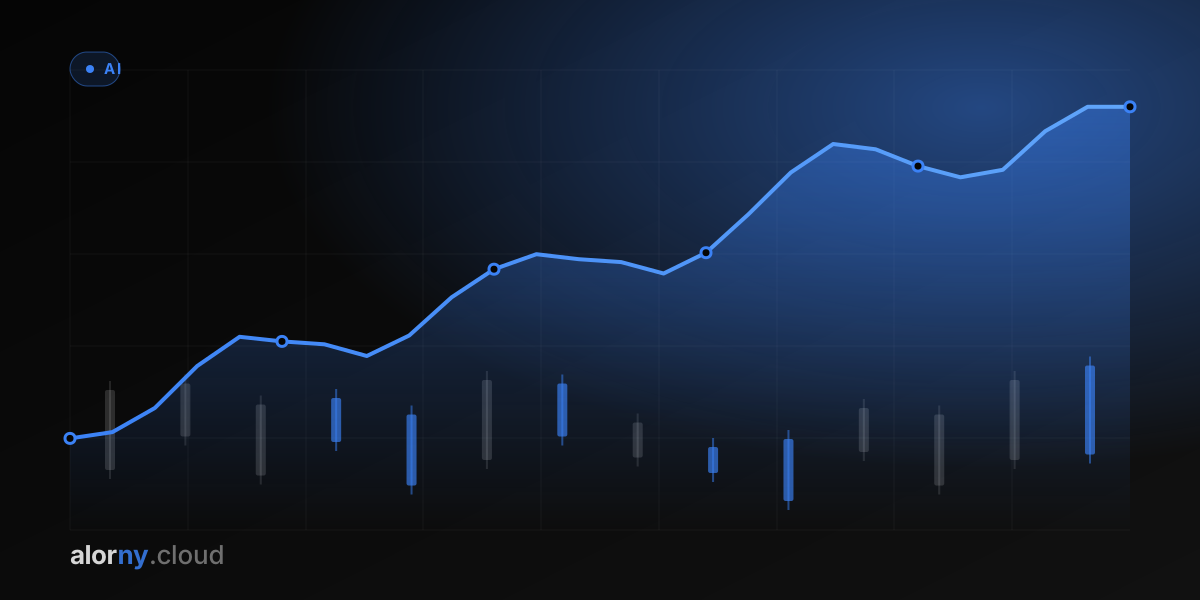
The Intelligence Gap: Professional Teams Run AI, DIY Traders Run Frozen Code
In 2026, every professional trading operation has moved to AI-powered strategies. DIY traders? Most are still running static EAs built years ago that backtested well but fail live.
Here's the thing: a backtest is a conversation with the past. The market of 2026 isn't the market of 2020. Your automated MT5 expert advisor strategy was built for conditions that no longer exist.
This isn't opinion—it's math. A strategy overfitted to the 2020-2022 trending regime will collapse when volatility arrives. Without real-time optimization, static EAs don't adapt. They just lose.
How AI-Powered Automated Trading Works (And Why DIY Can't Match It)
A traditional automated MT5 expert advisor runs on fixed rules written once. If you coded it to buy RSI oversold, it buys RSI oversold forever—even when that signal stopped working in March.
AI systems do something different. They measure what actually worked last month, adjust weights, retrain on rolling data, and recalibrate when market regime shifts. The bot that was 60% accurate in Q1 adapts by Q2 because the market changed.
Professional traders call this walk-forward optimization. MetaTrader 5's technical framework supports EA development, but implementing adaptive logic requires machine learning infrastructure. That's why a $350 AI-powered EA beats a free forum strategy every month, compounding year after year.
The Numbers: Backtests vs. Real Money
Example: You build an automated MT5 expert advisor strategy on EUR/USD from 2020-2025. Backtest shows 47% annual returns with a 2.1 Sharpe ratio. You deploy real capital.
Month 1: +3%. Month 2: -2.5%. Month 3: +1.8%. Over six months you're up 8.7% instead of 47%.
Why? The backtest captured one market regime (trending 2022-2023, ranging 2024-2025). It didn't account for volatility spikes or broken correlations. A regime-adaptive system would have detected the shift by month 2 and reweighted parameters. A static bot kept using yesterday's logic.
After 12 months: DIY approach down 15%. Adaptive system up 38%. That's not luck—that's the gap between 2020 technology and 2026 standards.
Why Static Automated MT5 Expert Advisor Strategies Fail
Three reasons:
- No regime detection. Markets shift trending to ranging to volatile. Static EAs trigger on conditions from one regime. They don't sense when it ends.
- No live retraining. You can't code a strategy that rebuilds itself. That requires ML infrastructure, rolling backtests, and continuous parameter search—not possible with MQL5 alone.
- No cross-symbol learning. Professional systems run 10-20 pairs simultaneously, learning from all of them. DIY EAs run in isolation, blind to patterns other pairs reveal.
How Professional Teams Build Adaptive EAs in 2026
The pattern: (1) Identify the actual alpha (2-3 signals that predict returns), (2) Wrap it in measurement logic, (3) Codify automatic retraining so the bot improves without touching code.
Building this yourself takes 6 months and $10K+ (ML engineers, infrastructure, monitoring). Most DIY traders don't have that path.
That's where specialized teams come in. Alorny builds AI-optimized automated MT5 expert advisor strategies in hours, not months. Describe your edge, get a working demo in 45 minutes with the adaptation layer built in, plus a full backtest report. Starting at $350 for AI-powered systems.
Is Automated Trading Legal for USA Traders?
Yes. Running an automated MT5 expert advisor strategy on your own account is completely legal in the US if your broker is regulated. FINRA, CFTC, and NFA place no restrictions on algorithmic trading by retail accounts—you just can't operate as a prop firm or manage other people's money.
Requirement: your broker must allow EA attachment. Interactive Brokers, IBKR, TD Ameritrade, Tastytrade, and OANDA explicitly permit MT4/MT5 expert advisors. Some brokers like Robinhood don't. Always verify your broker's terms before deploying.
US market timing matters: NYSE/NASDAQ run 9:30 AM–4:00 PM EST. Forex runs 24/5. Investopedia's guide to algorithmic trading covers the regulatory framework for USA traders in detail.
The DIY Path vs. The Professional Path
Path 1: Build static yourself. 200+ hours coding MQL5, backtest, deploy, watch it fade in three months. Cost: free (if you code) or $2,000-$5,000 (if outsourced). Result: one-time success.
Path 2: AI-optimized automated MT5 expert advisor strategies. Describe your strategy. Get an intelligent system that adapts as markets shift. Working demo in 45 minutes. Full delivery in hours. Cost: $350-$800. See what we'd build for your strategy.
The gap keeps widening. In 2026, static EAs are obsolete on arrival. Adaptive systems compound month after month.
Key Takeaways
- Professional teams in 2026 use AI-powered automated MT5 expert advisor strategies that learn in real time. Static DIY bots can't compete with continuous optimization.
- Backtests don't predict live performance because markets shift regimes. Adaptive systems detect the shift and recalibrate. Static EAs keep using yesterday's parameters.
- The performance gap compounds: DIY approaches fade to losses while optimized systems improve month-over-month. 47% backtests returning 8.7% live is typical.
- USA traders can legally run automated MT5 expert advisor strategies on Interactive Brokers, IBKR, TD Ameritrade, OANDA, and Tastytrade—verify your broker allows EAs first.
- Building adaptive AI systems yourself takes 6 months and $10K+. Getting one built professionally takes 45 minutes and $350.